
Quick Summary
HR payroll software connects employee attendance, working hours, shifts, leave, and payroll inputs in one workflow. Instead of collecting staff information from separate sheets or systems, managers can use consistent records to prepare payroll, review staffing, and spot discrepancies before salaries are processed.
Table Of Contents
Introduction
Retail staffing changes every day. Employees may work different shifts, weekends, overtime, or across multiple outlets. When attendance, leave, schedules, and payroll are managed separately, small mismatches create extra work. HR payroll software connects these workforce processes, helping retail teams manage employee information and payroll inputs more consistently.
Key Takeaways
Connect attendance, working hours, and payroll inputs.
Coordinate shifts, leave, and employee records.
Reduce repetitive payroll preparation.
Improve workforce visibility for managers.
Support centralized employee management across outlets.
What Is HR Payroll Software for Retail Businesses?
HR payroll software combines employee management and payroll-related processes in one system. Payroll software mainly focuses on salaries, deductions, overtime, and other pay components. HRMS software covers a wider employee lifecycle, including employee records, attendance, leave, shifts, and workforce administration.
Retail businesses need this broader view because staff schedules rarely follow fixed office hours. A cashier may work a weekend shift, a store manager may approve leave, and another employee may work overtime during a sales period. The software helps connect these inputs before payroll is prepared.
How Does HR Payroll Software Help Retail Businesses Manage Employees?
Tracking Employee Attendance and Working Hours
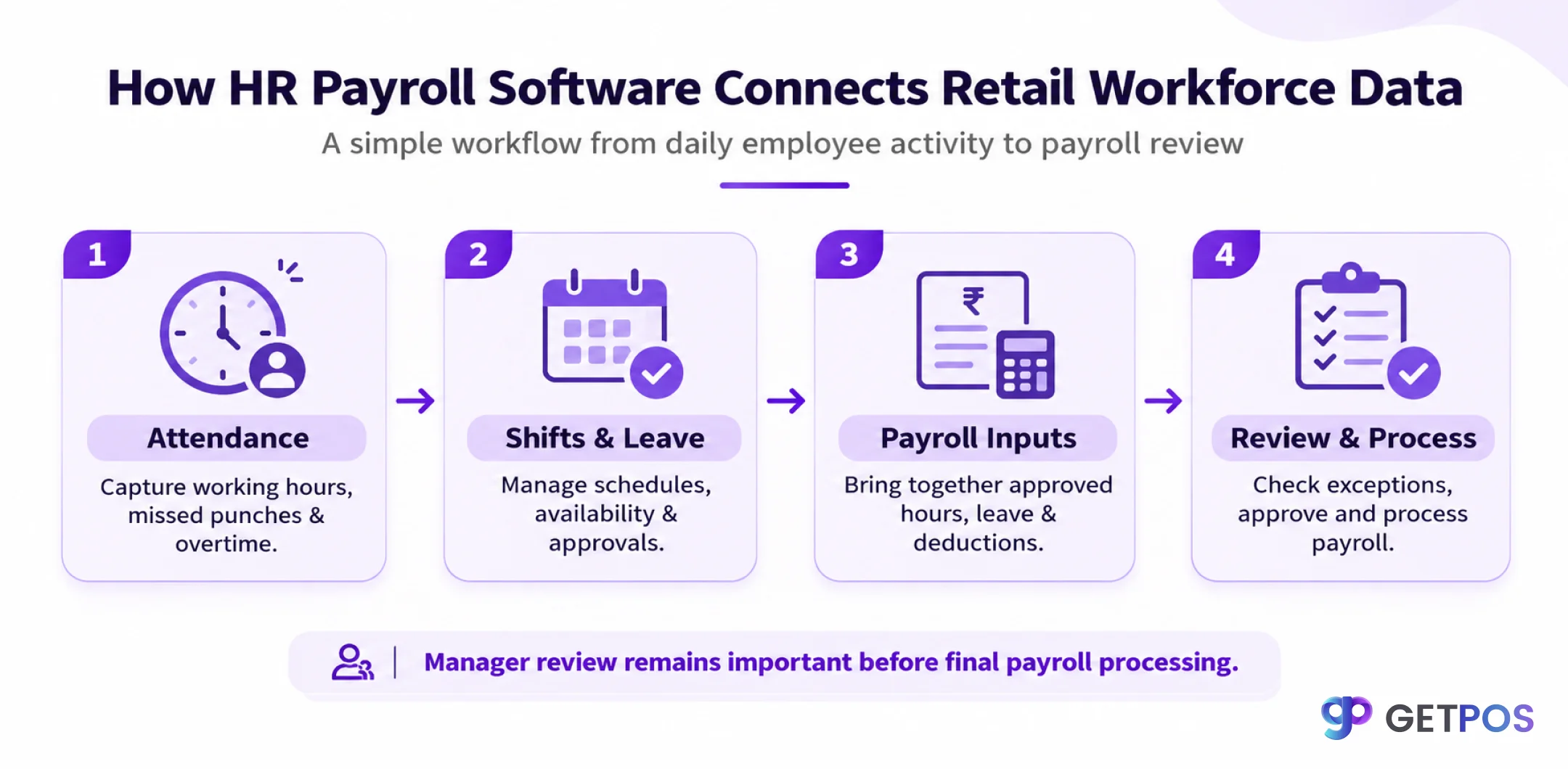
An employee attendance management system records when staff start and finish work. Managers can compare scheduled hours with actual attendance and review missed punches or overtime before payroll is prepared.
For example, extra hours during a weekend sale can be captured as a payroll input for manager review.
Managing Employee Shifts and Store Staffing
Retail staffing depends on weekends, holidays, peak shopping hours, employee availability, and seasonal demand. Employee scheduling software helps managers plan shifts instead of relying on scattered spreadsheets or messages.
Employee shift management makes staffing gaps and schedule changes easier to see and manage.
Calculating Salaries, Overtime and Deductions
Payroll management software uses approved attendance and payroll inputs to calculate configured salary components. These may include working hours, overtime, incentives, deductions, and other components.
Approved overtime can use attendance data as an input, while HR or payroll staff review final figures before processing.
Coordinating Leave Requests and Payroll Records
Leave management becomes easier when requests, approvals, attendance, and payroll records are connected. If an employee takes approved leave, the relevant record can be reviewed when preparing payroll.
If approved leave and attendance do not match, the record can be checked before payroll is finalized.
Managing Employees Across Multiple Retail Outlets
Multi-location retailers need centralized employee records, outlet-level schedules, permissions, and workforce visibility.
With multi-store management, a regional manager can review staffing across branches while access remains controlled by role and location.
What Retail Problems Can HR Payroll Software Solve?
The value of HR payroll software is easiest to understand through everyday problems:
Problem | Process | Practical outcome |
|---|---|---|
Manual attendance | Record attendance and review exceptions | Clearer payroll inputs |
Difficult shift changes | Maintain schedules in one place | Better staffing visibility |
Spreadsheet-based payroll | Connect attendance, leave and overtime | Less repetitive data entry |
Scattered employee information | Centralize employee records | Faster workforce access |
Different outlet processes | Standardize records and permissions | More consistent reporting |
What Should Retailers Look for in HR Payroll Software?
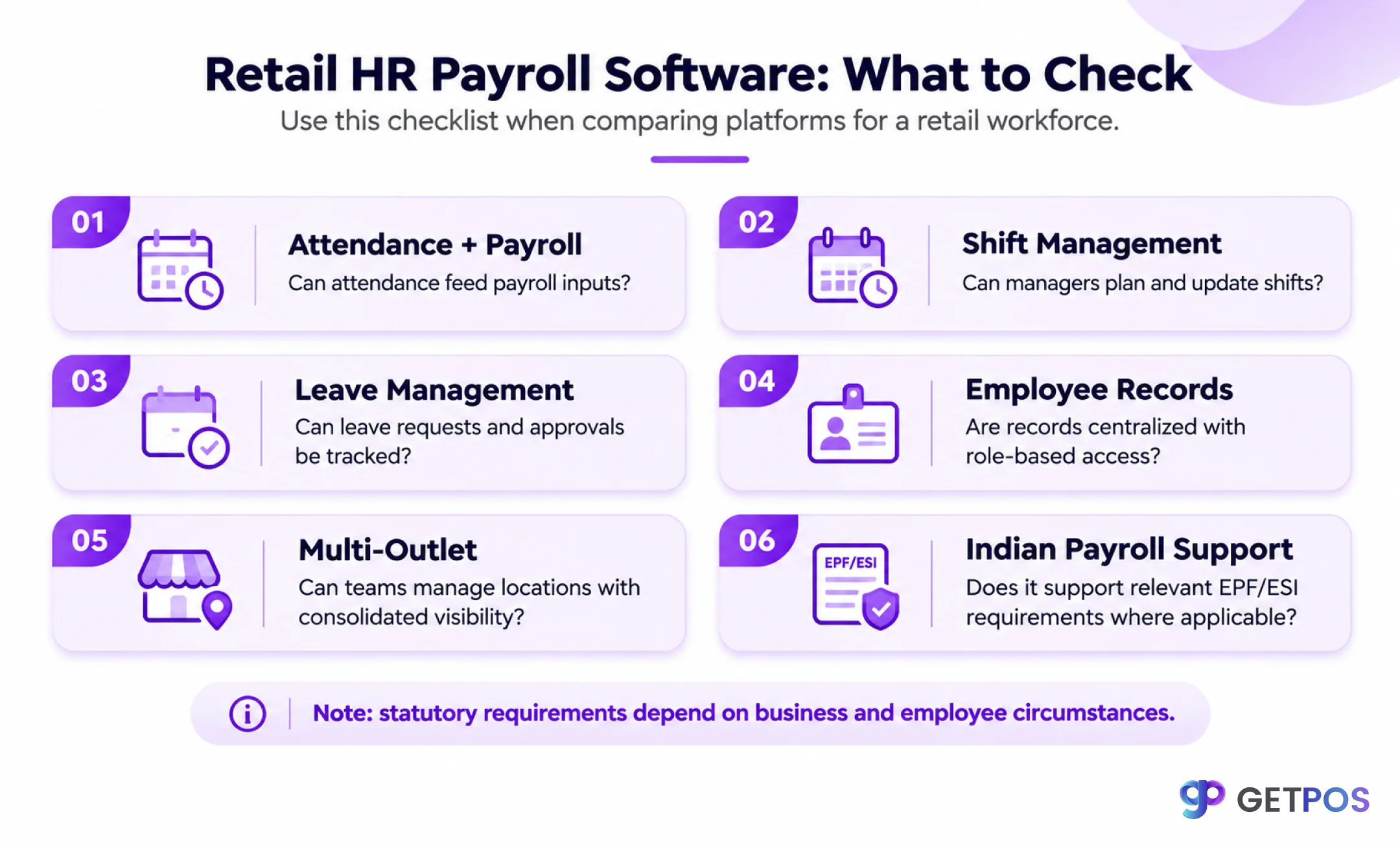
Start with the workflow, not only the feature list. A useful system should connect the information payroll depends on and make it easy for managers to review.
Attendance and payroll integration.
Employee scheduling and shift management.
Leave requests and approvals.
Employee records and role-based access.
Overtime, incentives, deductions, and payroll reporting.
Multi-outlet access and centralized workforce visibility.
Relevant Indian statutory payroll support, such as EPF and ESI, where applicable.
Statutory requirements depend on the business, employee category, location, and other circumstances. Software can support the process, but businesses should still review payroll settings and compliance requirements carefully.
How Does HR Payroll Software Fit into a Retail Operating System?
Workforce management becomes more useful when it sits alongside sales, inventory, purchasing, accounting, customers, and store activity.
For retailers evaluating retail management solutions
The value is having related business information available in one workflow.
A Retail Operating System can connect workforce processes with wider retail operations. GETPOS positions HR & Payroll alongside sales, inventory, purchasing, accounting, CRM, analytics, and multi-store operations.
Conclusion
HR payroll software helps retail businesses organize attendance, shifts, leave, employee records, and payroll inputs. It can reduce repetitive administration and improve workforce visibility, while managers still review and approve payroll information.
For growing retailers, the next step is to evaluate whether workforce management should remain separate or become part of a connected retail platform.
Explore GETPOS plans and pricing to compare platform options.
Frequently Asked Questions
HR payroll software combines employee information and payroll processes in one system. It can connect attendance, working hours, leave, shifts, salary components, deductions, and payroll records. Features vary, so retailers should confirm the fit for their workforce.
Payroll software organizes inputs such as working hours, overtime, leave, deductions, and salary components. Connected records reduce manual collection and leave more time for reviewing payroll.
Payroll software focuses on salary processing and calculations. HRMS software covers wider employee processes, including records, attendance, leave, shifts, and workforce administration. Some platforms combine both.
Attendance can provide payroll inputs such as working days, hours, overtime, and approved exceptions. Connected records make discrepancies easier to identify before payroll is finalized.
Yes. Many systems support multiple locations through centralized records, outlet-level access, scheduling, attendance, and reporting. Check for location-based permissions and consolidated workforce visibility.