
Quick Summary
AI retail software helps retailers turn sales, inventory and customer data into practical decisions. It can support demand forecasting, identify stockout and overstock risks, reveal product trends and connect customer behaviour with sales performance. The biggest value is not simply automation; it is giving retailers a clearer view of what is happening, why it matters and what action to take next.
Table Of Contents
Introduction
Retail decisions often depend on information spread across sales reports, inventory records, customer data and store operations. When these signals are reviewed separately, important patterns can be missed or discovered too late. AI retail software brings these data points together and uses analytics, forecasting and pattern detection to support faster decisions. For retailers, the practical question is not whether AI sounds advanced. It is whether AI can help answer everyday questions such as what to reorder, what is slowing down, which products are gaining demand and where customer behaviour is changing.
Key Takeaways
AI retail software connects data from sales, inventory and customer activity so retailers can make decisions from a more complete view.
AI demand forecasting can support stock planning by identifying expected demand and changing patterns.
Predictive insights can highlight possible stockout, overstock and slow-moving inventory risks before they become larger problems.
Retail sales and customer analytics can help retailers understand product performance, purchasing preferences and changes in demand.
The strongest results come when AI insights are connected to practical workflows such as replenishment, transfers, reporting and store-level actions. Retailers should evaluate data quality, integration, explainability, usability and implementation effort before choosing AI retail software.
How Is AI Retail Software Different from Traditional Retail Analytics?
Traditional retail analytics is often focused on reporting what already happened: sales last week, stock on hand, top-selling products or revenue by store. AI-supported analytics can go a step further by identifying patterns, estimating what may happen next and surfacing signals that deserve attention.
For a broader overview of retail AI applications, see the GETPOS guide to AI applications in modern retail.
How Do Reporting, Automation and AI Differ?
Reporting answers: What happened?
Automation answers: What repeatable task should happen automatically?
AI-supported analytics answers: What pattern or risk should we pay attention to, and what could happen next?
These capabilities work best together. A retailer can use reporting for visibility, automation for repetitive work and AI-supported analysis for decisions that benefit from forecasting or pattern recognition.
How Does Retail Data Become Actionable Insight?
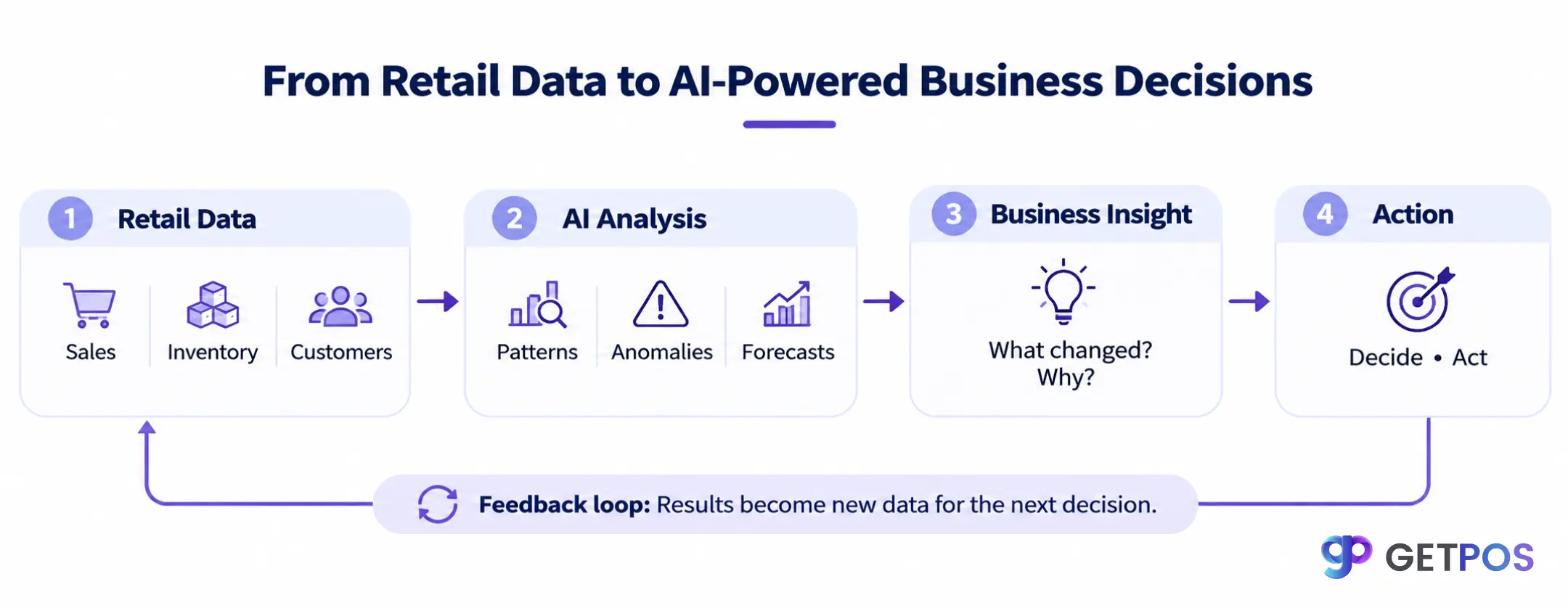
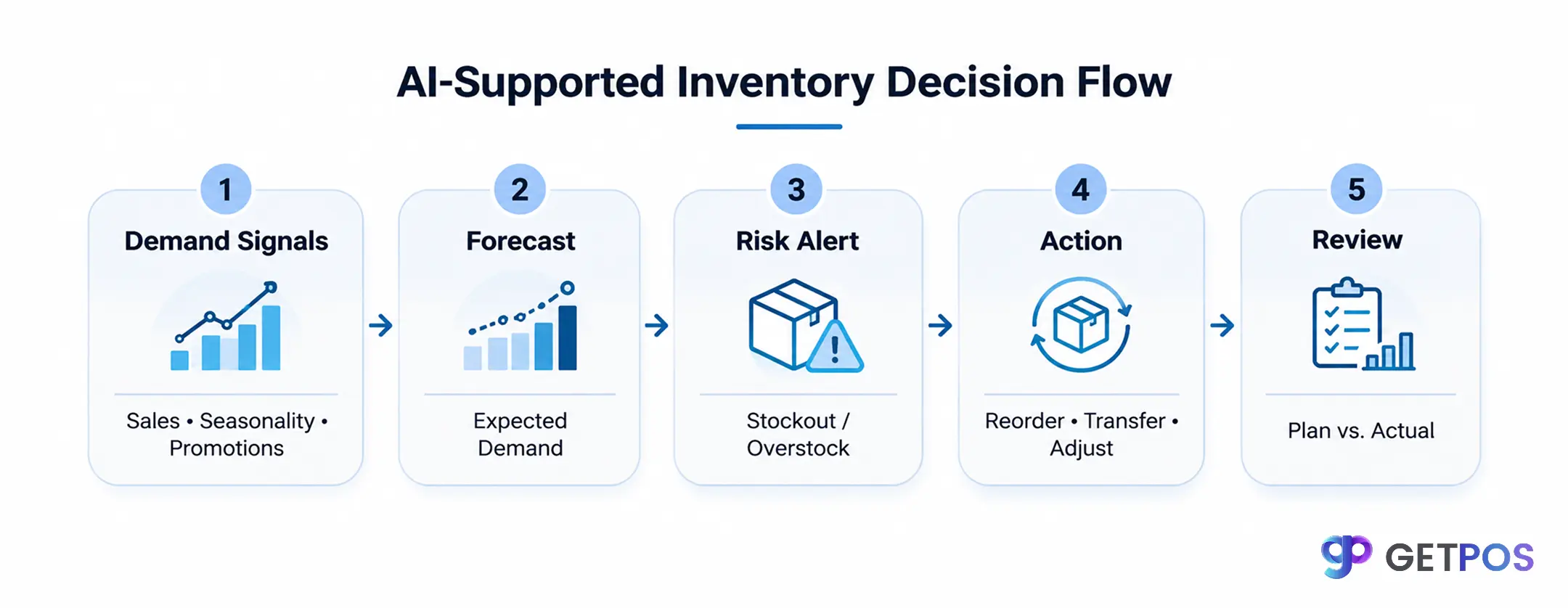
The useful sequence is simple: collect reliable data, analyse it, identify a meaningful signal and connect that signal to an action. If a system only produces another dashboard, the retailer still has to find the problem manually. The goal is to reduce that gap between data and decision.
How Can AI Support Retail Inventory and Demand Decisions?
Inventory decisions become difficult when demand changes faster than manual planning can keep up. AI inventory management can use historical sales and other available signals to support demand estimates, identify unusual movement and highlight products that may need attention. For the operational foundations behind these decisions, see the GETPOS guide to retail inventory management.
How Can AI Demand Forecasting Improve Stock Planning?
AI demand forecasting can help estimate expected demand by product, store or period. Instead of relying only on an average sales number, a retailer can look for changes in sales patterns and use those signals to support replenishment planning. The practical benefit is better timing: retailers can review which products need replenishment sooner, which items may need less stock and where demand is moving differently from the normal pattern.
How Can Predictive Insights Identify Overstock and Stockout Risks?
Stockouts can lead to missed sales, while excess stock ties up working capital and can create ageing or dead-stock problems. Predictive insights can help flag products where expected demand and current stock levels appear out of balance. These alerts should support—not replace—retailer judgement because promotions, local events, supplier issues and seasonal changes can affect the signal.
Practical Example — Grocery Inventory Planning
Example: A grocery retailer sees unusually fast sales for a high-demand product in two stores. An AI-supported system can flag the change, compare current stock with expected demand and help the team decide whether to reorder, transfer stock from another store or monitor the item more closely.
How Can AI Reveal Sales Trends and Customer Demand?
Sales data becomes more useful when retailers can see not only which products sell, but also how performance is changing. AI-supported retail analytics can help identify patterns across products, stores, time periods and customer groups.
Retailers looking to strengthen this capability can explore retail analytics software for connected dashboards and performance visibility.
How Can AI Identify Sales Trends and Product Performance?
Start with the retail analytics fundamentals to understand how descriptive, diagnostic and predictive views fit together.
AI can help surface products with accelerating demand, declining sales, unusual store-level performance or changing basket behaviour. The important step is to turn those observations into questions: Is demand changing across all stores or only one? Is the change seasonal? Is a promotion driving it? Does inventory support the trend?
How Can Customer Analytics Reveal Purchasing Preferences?
Customer analytics can help retailers understand repeat purchases, product combinations, customer segments and changes in buying behaviour. When these signals are connected with sales and inventory, retailers can make more informed decisions about assortment, promotions and stock allocation.
How Does Connected Retail Data Improve Business Decisions?
AI is most useful when the data it analyses is connected. Sales data alone can show what sold. Inventory data can show what is available. Customer data can show who is buying. Together, these signals can explain what is changing and help retailers decide what to do next.
How Do Inventory, Sales and Customer Insights Work Together?
Consider a product with rising sales. Sales analytics identifies the increase. Inventory analytics checks whether enough stock is available. Customer analytics can show which shoppers are driving the demand. The combined view is more useful than any one report because it connects performance with the operational decision.
How Can Retailers Turn AI Insights into Practical Actions?
A useful AI workflow should lead to a clear next step: reorder, transfer, investigate, promote, adjust an assortment decision or monitor a risk. Retailers should define the action before adding more analytics. Otherwise, the business can end up with more alerts but not better decisions.
For repeatable operational actions, see how retail automation workflows can reduce manual steps around retail operations.
Example — Responding to Rising Product Demand
Decision Example
Signal: product sales are rising in selected stores.
Check: current stock, incoming purchase orders and customer demand.
Action: replenish or transfer stock where the demand is strongest.
Review: compare the forecast with actual sales and adjust the next planning cycle.
What Should Retailers Check Before Adopting AI Retail Software?
AI retail software should be evaluated as a business system, not only as an AI feature. The retailer needs reliable data, usable workflows and clear actions. If the platform cannot connect insights to day-to-day operations, the value of the analytics may remain limited.
Which AI and Analytics Capabilities Should Retailers Evaluate?
Data connectivity: Can sales, inventory and customer data be brought together reliably?
Forecasting: Can the system support demand planning at the product and store level?
Risk detection: Can it surface stockout, overstock or unusual-performance signals?
Analytics: Can teams move from summary reporting to useful explanations and trends?
Actionability: Can insights lead to clear operational actions instead of another dashboard?
Usability: Can store and management teams understand the outputs without specialist skills?
What Implementation Risks Should Retailers Consider?
Poor or inconsistent source data can reduce the quality of AI-supported insights.
Disconnected systems can make it difficult to create one reliable view of the business.
Too many alerts can create noise if thresholds and workflows are not defined.
AI recommendations still need business context and human review for unusual situations.
Teams need clear ownership so someone is responsible for acting on important insights.
Conclusion
AI retail software can make retail data more useful by connecting inventory, sales and customer signals in one decision process. The strongest use cases are practical: forecasting demand, spotting inventory risks, understanding product performance and helping teams decide what to do next. Retailers should focus less on AI as a buzzword and more on whether the software improves specific decisions, fits existing workflows and gives teams insights they can act on.
Buyer Checklist Before choosing a platform, ask: What data will it use? What decisions will it improve? How are recommendations explained? How will teams act on alerts? How does the system fit existing retail workflows?
Frequently Asked Questions About AI Retail Software
AI retail software uses artificial intelligence and analytics to help retailers understand data, identify patterns, forecast demand and support business decisions. Its value depends on how well those insights connect to real retail workflows.
AI can support inventory planning by analysing sales patterns, estimating demand and highlighting possible stockout, overstock or slow-moving risks. Retail teams can then use those signals to support replenishment, transfers and monitoring.
AI can identify changes in product performance, store-level trends and unusual sales patterns. It can help retailers move from simply reviewing historical reports to investigating what is changing and what may need attention next.
Yes. Customer analytics can help identify purchasing patterns, repeat behaviour, segments and product preferences. When connected with sales and inventory data, these insights can support assortment, promotion and allocation decisions.
Look at data quality, system integration, forecasting and analytics capabilities, usability, explainability and the workflows that turn insights into action. The best fit is the platform that solves specific retail decisions, not simply the one with the longest AI feature list.