
Quick Summary
Retail inventory management is the process of tracking, controlling, and replenishing products so retailers maintain the right stock at the right location and time. Effective inventory management for retail helps reduce stockouts, overstock, dead stock, and inventory inaccuracies while improving product availability, cash flow, and overall inventory optimization.
Table Of Contents
Introduction
Retail inventory management has a direct impact on sales, cash flow, and customer experience. When stock records are accurate, retailers can see what is available, where it is located, and when replenishment is needed.
Strong retail stock management reduces unnecessary inventory costs while helping high-demand products stay available.
Key Takeaways
Retail inventory management controls stock from receiving through selling, transferring, returning, and replenishment.
Accurate stock records help retailers reduce stockouts, overstock, dead stock, and inventory discrepancies.
Reorder points, safety stock, ABC analysis, and cycle counting are practical methods for improving retail inventory control.
Demand forecasting and automated replenishment can help retailers maintain healthier inventory levels.
Inventory management software provides a connected view of stock across stores and warehouses.
What Is Retail Inventory Management?
Retail inventory management is the process of monitoring products from the time they are received until they are sold, transferred, returned, or replenished. It includes tracking quantities, product movement, locations, purchasing, and inventory accuracy. The goal is simple: keep enough stock to meet demand without tying unnecessary cash into excess inventory.
For a retailer, inventory is not just a number on a report. It is a moving stream of products that changes with every sale, receipt, return, transfer, and adjustment. A structured inventory process gives teams a reliable view of that movement and helps them act before small discrepancies become expensive operational problems.
Why Is Inventory Management Important for Retail?
Effective retail inventory control affects sales, working capital, purchasing, and customer experience. Too little stock can create stockouts and lost sales, while too much can increase holding costs and leave cash tied up in slow-moving or dead inventory.
Accurate inventory data also makes purchasing more disciplined. Instead of ordering because a shelf looks empty or because a supplier is offering a discount, teams can review actual stock levels, recent sales, replenishment needs, and product movement before committing cash.
For multi-location retailers, the challenge becomes even greater. Stock may be available in one store while another location is running short. Centralized visibility can help managers identify these gaps and decide whether to replenish, transfer, or adjust purchasing.
Key Retail Inventory Control Methods
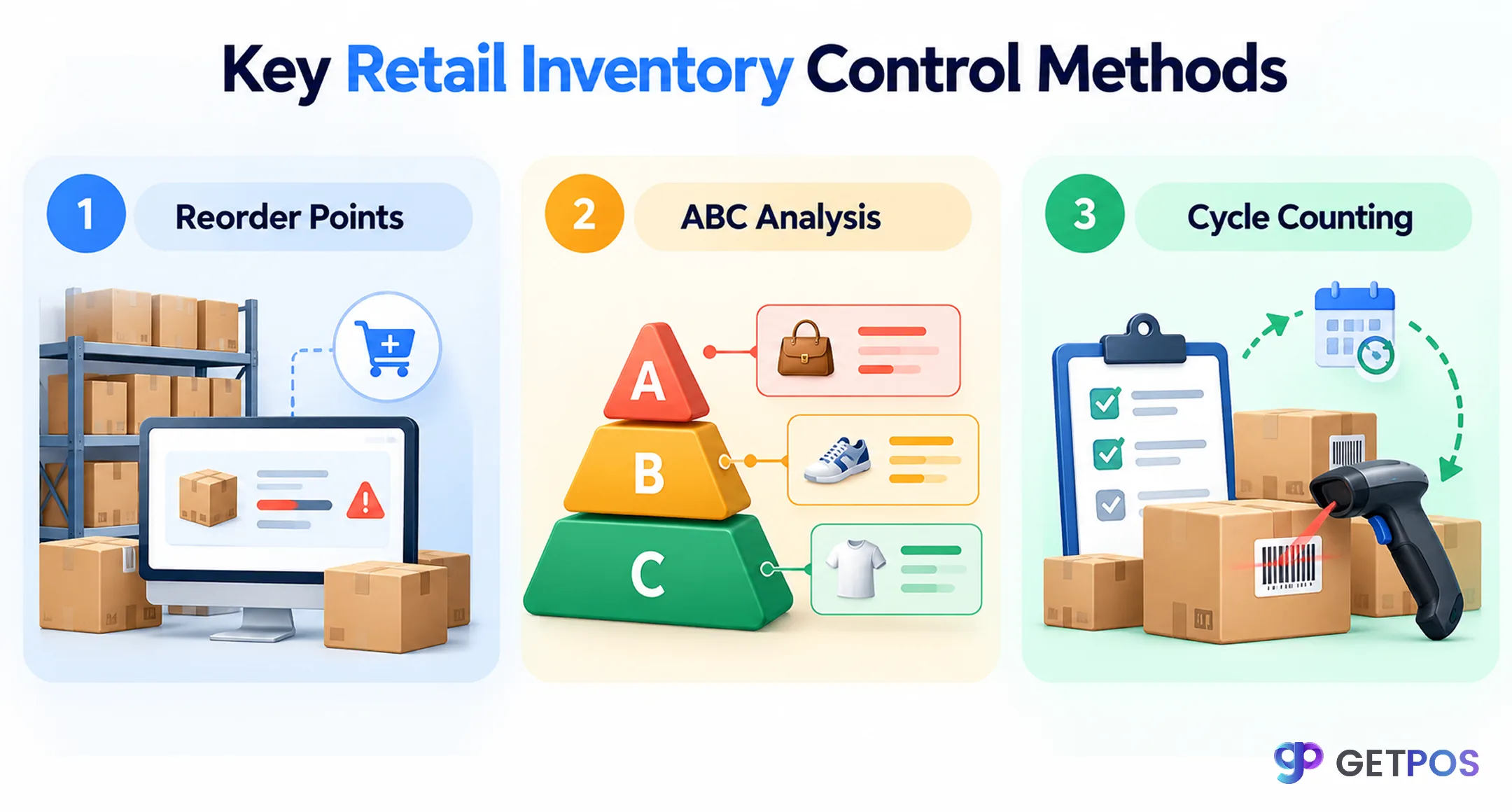
Retail inventory control works best when several methods are combined rather than treated as separate activities. Reorder points help determine when to replenish, safety stock provides a buffer, ABC analysis helps prioritize attention, and cycle counting keeps records aligned with physical stock.
Reorder Points and Safety Stock
A reorder point identifies when a product should be replenished before available inventory reaches a critical level. Retailers can consider average demand, supplier lead time, and expected fluctuations when setting this threshold. Safety stock adds a buffer for unexpected demand or supply delays, helping protect availability without encouraging unnecessary purchasing.
ABC Analysis and Stock Prioritization
ABC analysis helps retailers prioritize products according to value, demand, or business importance. High-value or high-impact products can receive closer monitoring, while lower-priority products may require less frequent intervention. This approach helps teams focus their time where inventory decisions can have the greatest business impact.
Cycle Counting and Inventory Accuracy
Cycle counting means checking selected inventory regularly instead of relying only on a large periodic physical count. It can reveal discrepancies caused by sales, returns, transfers, receiving errors, damage, or misplaced products. Regular targeted checks also make it easier to investigate a discrepancy while the transaction history is still fresh.
How to Optimize Retail Inventory Levels
Retailers can improve inventory optimization by balancing product availability with the cost of holding excess stock. Start by reviewing historical sales and identifying fast-, slow-, and non-moving products. Then establish suitable minimum and maximum stock levels based on demand patterns, supplier lead times, seasonality, and business priorities.
Inventory forecasting can strengthen this process by helping teams estimate future demand instead of relying only on past stock levels. Replenishment decisions can then consider expected demand, current availability, supplier lead time, and stock already in transit.
Retailers can also use inventory optimization tools to identify ageing stock, understand movement, and support smarter replenishment decisions. The objective is not to keep the maximum amount of inventory; it is to keep the right inventory in the right place at the right time.
How Retail Inventory Management Software Improves Stock Control
Modern inventory management software can connect sales, purchasing, stores, and warehouses so teams work from a shared stock position. This reduces dependence on disconnected spreadsheets and makes inventory information easier to access when managers need to make purchasing or replenishment decisions.
A connected retail inventory management platform can provide real-time stock visibility, stock movement history, low-stock alerts, ageing information, and inventory reporting. These capabilities help turn inventory data into an operational workflow rather than a report that is reviewed only after a problem occurs.
Real-Time Visibility and Low-Stock Alerts
Real-time visibility helps retailers understand current stock availability without waiting for manual reports. When sales, receipts, transfers, and other inventory movements update the system, teams can use the latest information to decide what needs attention.
Low-stock alerts make this even more actionable. Instead of discovering that a best-selling product has already reached zero, teams can receive a signal when inventory approaches its defined reorder level and start replenishment earlier.
Multi-Store Tracking and Replenishment
Managing inventory across multiple stores adds another layer of complexity. A product may be unavailable in one outlet while excess stock sits in another, creating avoidable purchasing pressure. A connected multi-location view helps managers see where inventory is available before placing another order.
For retailers operating several outlets, multi-store inventory management can provide a centralized view of stock and make store-to-store transfers easier to coordinate. This is particularly useful when demand differs by location and the business wants to use existing inventory more efficiently.
Retail Inventory Management Best Practices
Good inventory management is built through consistent daily practices. Technology can improve visibility, but retailers still need clear processes for receiving, counting, replenishment, transfers, and purchasing. The following practices create a practical foundation for better stock control.
Maintain Records and Reorder Levels
Keep inventory records updated after sales, purchases, returns, transfers, and adjustments.
Set reorder levels based on demand, lead time, and the importance of the product.
Monitor fast- and slow-moving products so purchasing decisions reflect actual movement.
Review inventory data before placing purchase orders instead of relying only on intuition.
Monitor Stock Movement and Count Regularly
Perform regular cycle counts to identify discrepancies early.
Track inventory across every store and warehouse so managers know where stock is available.
Review ageing and dead stock and take action through transfers, promotions, markdowns, or purchasing changes where appropriate.
Conclusion
Effective retail inventory management is about maintaining the right product, in the right quantity, at the right location, at the right time. Strong retail inventory control reduces stockouts, limits unnecessary overstock, improves inventory accuracy, and supports better purchasing decisions.
As a retail business grows, spreadsheets and disconnected tools can make stock visibility harder to maintain. A connected Retail Operating System can bring sales, inventory, purchasing, warehouse operations, and reporting into one connected environment. This gives retail teams a clearer operational picture and a stronger foundation for growth.
Ready to improve inventory visibility and stock control? Book a free GETPOS demo and see how a connected Retail Operating System can help manage inventory across your retail operations.
Frequently Asked Questions About Retail Inventory Management
Retail inventory management is the process of tracking, controlling, selling, transferring, and replenishing products across retail locations. It helps businesses maintain appropriate stock levels while reducing stockouts, excess inventory, dead stock, and inventory inaccuracies.
Inventory management helps retailers maintain product availability while controlling the amount of capital tied up in stock. Accurate records can reduce stockouts, overstocking, unnecessary carrying costs, and discrepancies between system records and physical inventory.
Common methods include reorder points, safety stock, ABC analysis, cycle counting, and stock-level monitoring. Retailers can combine these methods according to product value, demand, location, supplier lead time, and operational requirements.
Retailers can improve inventory optimization by analyzing historical sales, identifying fast- and slow-moving products, using demand forecasting, setting appropriate reorder levels, monitoring dead stock, and automating replenishment where practical.
A retail inventory system should ideally provide real-time stock tracking, low-stock alerts, multi-location visibility, stock movement history, inventory ageing, reporting, and replenishment capabilities. The right feature set depends on the retailer's size, product complexity, and number of locations.