
Quick Summary
Retail Promotion ROI helps retailers understand whether discounts, festive offers and marketing campaigns are actually making money. A rise in sales does not always mean higher profits. By comparing normal sales, promotional revenue, product margins and campaign expenses, retailers can calculate their actual returns and identify which promotions are worth repeating.
Table Of Contents
Introduction
Imagine running a Diwali sale at your retail store. You offer discounts of up to 30%, attract more customers and record higher sales than usual. But after reducing product prices and paying for advertising, are you actually making more profit?
This is a common challenge for Indian retailers. Whether you operate a grocery store, fashion outlet or multi-store business, Retail Promotion ROI helps you understand whether a sales promotion is delivering the financial results you expected. In this guide, you will learn how to calculate it, measure sales growth and protect your profit margins.
Key Takeaways
Measure additional profit, not just total promotional sales.
Use a consistent formula to calculate promotion ROI.
Compare campaign results with normal sales.
Check how discounts affect product margins.
Track performance across products, campaigns and stores.
1. What Is Retail Promotion ROI?
Retail Promotion ROI measures how much additional profit a retailer earns from a promotional campaign compared with the additional money spent on that campaign.
In simple terms, it answers one important question: After offering discounts and paying campaign expenses, did the promotion actually make the business more profitable?
Why Is Promotion Effectiveness Important?
Measuring promotion effectiveness helps retailers understand:
Which discounts are generating additional profit?
Are customers buying more because of the offer?
Are discounts reducing product margins?
Which campaigns should be repeated or discontinued?
For example, a clothing retailer may sell 200 extra shirts during a festive sale. However, if the discount is too high, the additional sales may not cover the lost margin and advertising expenses. That is why sales growth and profitability should always be evaluated separately.
2. How to Calculate Retail Promotion ROI
To calculate Retail Promotion ROI, you first need to know how much additional profit your campaign generated and how much extra money you spent to run it.
Retail Promotion ROI Formula
ROI (%) = [(Incremental Profit − Promotion Cost) ÷ Promotion Cost] × 100
Here is what each term means:
Incremental Profit: Additional gross profit earned during the promotion compared with the expected profit without the offer.
Promotion Cost: Additional expenses such as advertising, printed materials, promotional staffing and campaign execution.
Net Promotional Return: Incremental profit remaining after deducting additional campaign expenses.
Important: Calculate gross profit using the actual discounted selling price. If the discount has already reduced your selling price and gross profit, do not subtract that same discount again as a separate expense.
Retail Promotion ROI Calculation Example in ₹
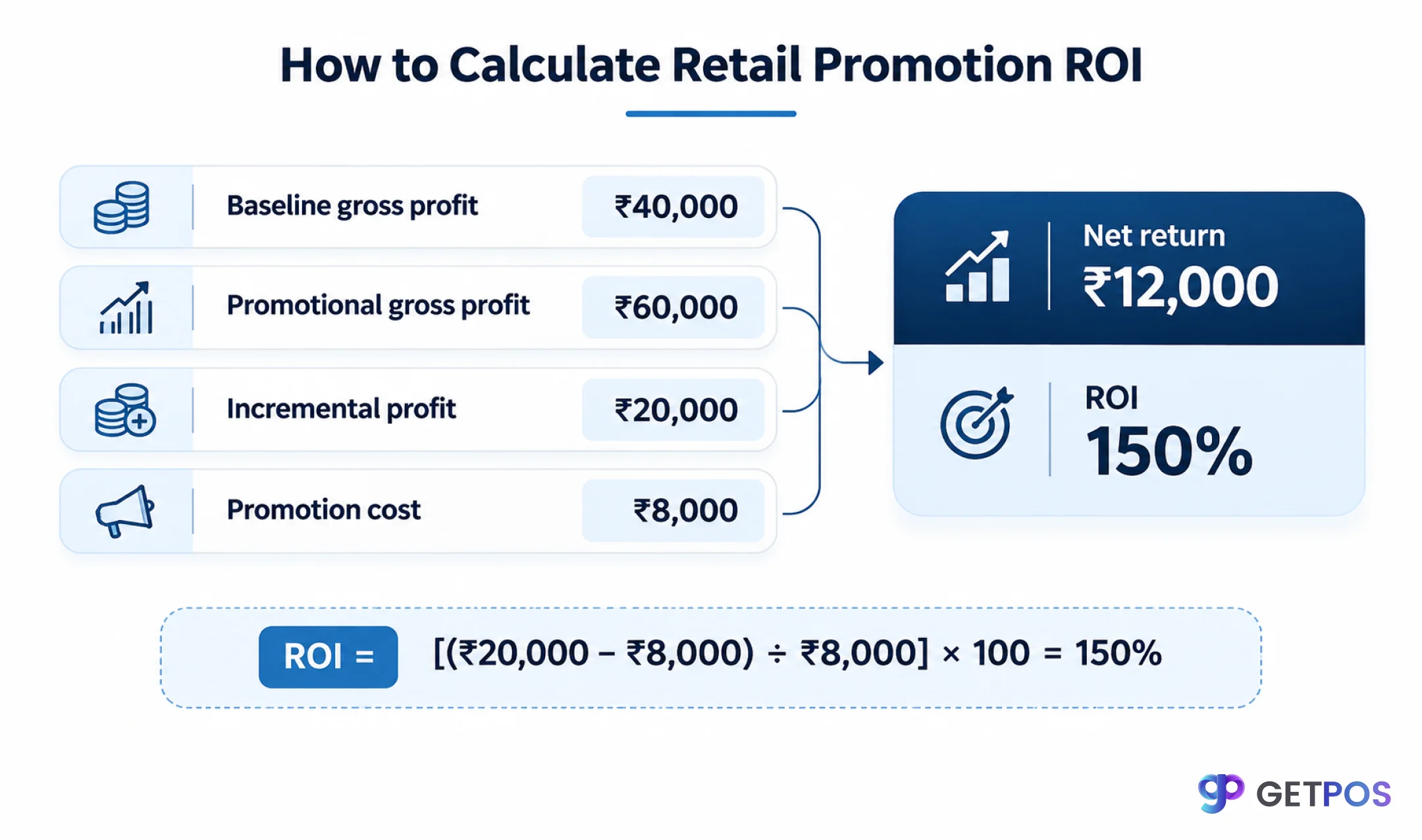
Suppose a fashion retailer in India runs a festive discount campaign. Before the campaign, the store normally generates ₹40,000 in gross profit. During the promotion, gross profit increases to ₹60,000. The retailer also spends ₹8,000 on advertising and other promotional activities.
Metric | Amount |
|---|---|
Gross profit without promotion | ₹40,000 |
Gross profit during promotion | ₹60,000 |
Incremental profit | ₹20,000 |
Additional promotion expenses | ₹8,000 |
Net promotional return | ₹12,000 |
Retail Promotion ROI | 150% |
ROI Calculation: [(₹20,000 − ₹8,000) ÷ ₹8,000] × 100 = 150%
The retailer generated ₹20,000 in additional gross profit and spent ₹8,000 to run the campaign. After deducting those expenses, ₹12,000 remained. For every ₹1 spent on the campaign, the retailer generated ₹1.50 in net incremental return.
This is a simplified example based on incremental gross profit and separately identified campaign expenses. Other business costs and indirect effects are not included.
3. How to Measure Sales Lift During Retail Promotions
Sales lift tells you how much your sales increased during a promotion compared with what your store would normally have sold without the offer.
What Are Baseline Sales and Incremental Sales?
Baseline Sales: The sales your store would normally expect without a promotion.
Promotional Sales: The actual sales recorded while the offer is running.
Incremental Sales: The additional sales generated above the normal sales level.
Sales Lift Formula With Example
Sales Lift (%) = [(Promotional Sales − Baseline Sales) ÷ Baseline Sales] × 100
Metric | Amount |
|---|---|
Normal expected sales | ₹2,00,000 |
Actual promotional sales | ₹2,50,000 |
Additional revenue | ₹50,000 |
Sales lift | 25% |
The store normally generates ₹2,00,000 in sales. During the promotional period, sales reach ₹2,50,000. Therefore, the business records a 25% sales lift.
But higher sales do not automatically mean the promotion caused the increase. For a fair comparison:
Compare the same weekdays and similar selling periods.
Consider seasonal demand and festive occasions.
Check whether product prices changed.
Account for products that went out of stock.
Compare stores with similar customer demand.
4. How Retail Promotions Affect Profit Margins
One of the biggest mistakes retailers make is assuming that selling more products always means earning more money. Discounts can increase sales volume while reducing the profit earned on each product.
Why Can Higher Sales Still Reduce Profit?
Consider a retailer selling a product for ₹1,000. The product costs ₹600, leaving ₹400 in gross profit. Now, the retailer offers a discounted price of ₹800. The gross profit per unit falls to ₹200. Even if more customers purchase the product, the retailer must sell enough additional units to compensate for the lower profit.
Example: Sales Growth vs Profit Impact
Metric | Before Promotion | During Promotion |
|---|---|---|
Selling price per unit | ₹1,000 | ₹800 |
Product cost | ₹600 | ₹600 |
Units sold | 100 | 130 |
Total revenue | ₹1,00,000 | ₹1,04,000 |
Gross profit | ₹40,000 | ₹26,000 |
Gross profit margin | 40% | 25% |
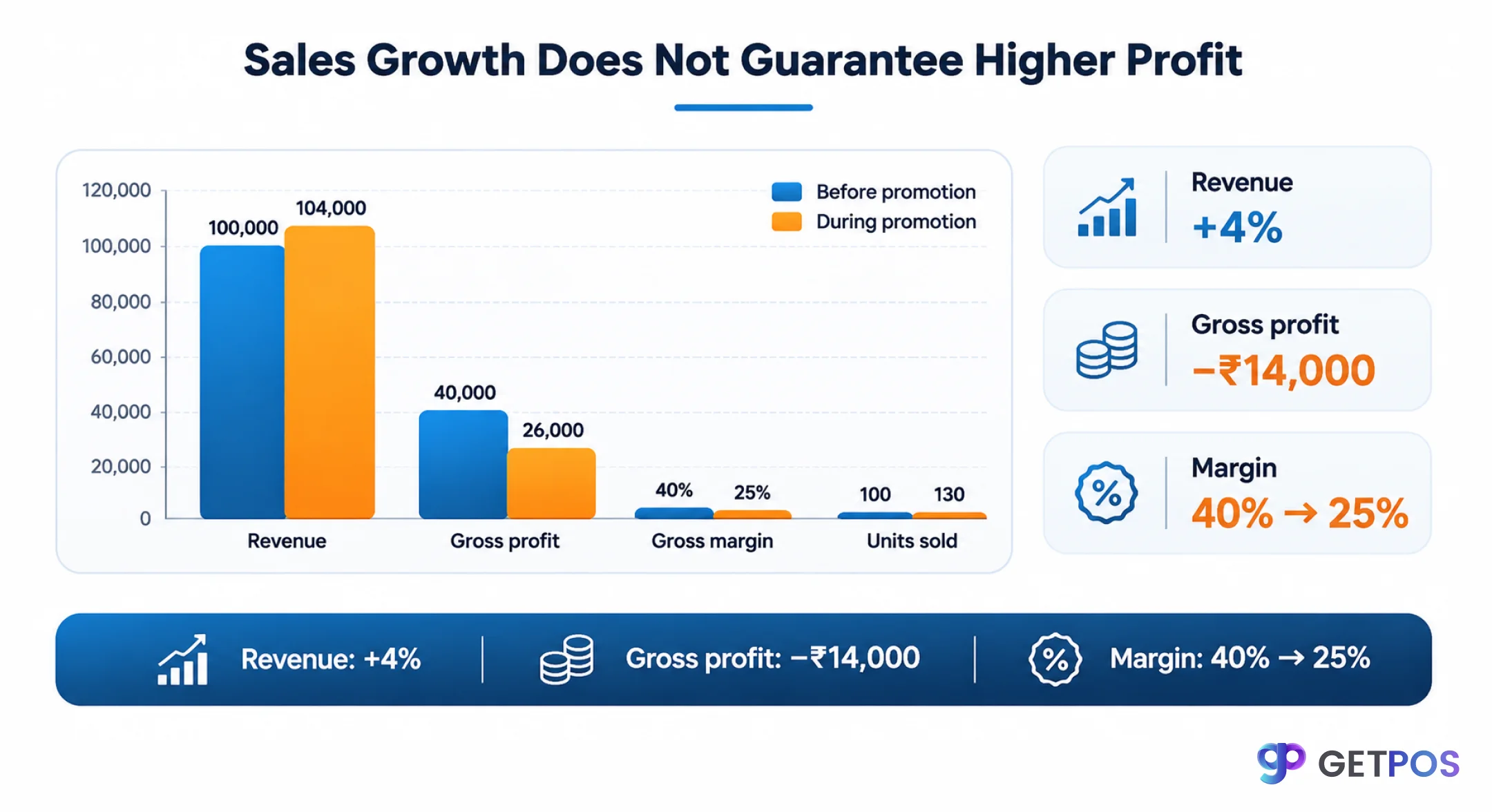
The retailer sold 30 additional units, and revenue increased by 4%. However, gross profit fell from ₹40,000 to ₹26,000. That is a ₹14,000 reduction in gross profit, even before additional advertising or campaign expenses.
Before offering a discount, calculate whether the additional sales volume can compensate for the reduced profit per unit.
5. Key Metrics to Track Retail Promotion Performance
Looking at revenue alone will not give you a complete picture of campaign performance. Retailers should monitor multiple indicators to understand what is working and where money is being lost.
Metric | How to Calculate It | Why It Matters |
|---|---|---|
Incremental Revenue | Actual Revenue − Baseline Revenue | Shows additional sales |
Gross Profit | Net Sales − Product Cost | Shows product profitability |
Promotion Cost | Total Additional Campaign Expenses | Measures campaign investment |
Sales Lift % | Incremental Revenue ÷ Baseline Revenue × 100 | Measures sales growth |
Average Transaction Value | Net Revenue ÷ Number of Transactions | Shows average customer spending |
Units Sold | Total Units Sold | Measures sales volume |
Customer Acquisition Cost | Acquisition Spend ÷ New Customers | Measures acquisition cost |
Customer Acquisition Cost (CAC) is especially useful when a campaign is designed to bring new customers into the store. For accurate reporting, use consistent revenue figures after accounting for returns, refunds and applicable taxes.
6. Common Mistakes When Calculating Retail Promotion ROI
Even when retailers collect sales data, a few common mistakes can lead to incorrect campaign results.
Counting total sales instead of additional profit: This makes a campaign appear more successful than it really is.
Deducting discounts twice: If the discount is already reflected in gross profit, do not count it again as a separate expense.
Ignoring advertising expenses: Include the additional money spent to promote the offer.
Using the wrong baseline: Compare promotional sales with realistic normal sales.
Ignoring product margins: Some products cannot support deep discounts.
Leaving out returns and refunds: Cancelled or refunded orders should not inflate campaign results.
Use the same method to calculate normal sales, promotional profit and campaign expenses every time you evaluate an offer.
7. How Retail POS Software Helps Measure Promotion ROI
Calculating promotional performance becomes difficult when sales, discounts and product information are stored in different places. Retailers need reliable transaction data to understand what customers purchased, which discounts were applied and how different products performed.
What Should You Track Through Retail POS Software?
Retailers can use a retail POS system to review the following records.
Product-wise and transaction-wise sales records.
Discount and coupon usage.
Sales comparisons before and during promotions.
Product-level sales and gross profit information.
Performance comparisons across multiple stores.
How GETPOS Supports Retail Promotion Analysis
GETPOS is an AI Based Retail Operating System that connects retail sales, inventory management and reporting workflows. For retailers operating multiple outlets, connected business information can make it easier to review sales performance, monitor inventory movement and compare store-level results.
For example, a fashion retailer can review which products sold during a festive campaign, check their inventory movement and compare performance across outlets. This information can support better promotional decisions. However, an accurate ROI calculation still requires baseline sales, incremental profit and campaign expenses to be identified separately.
8. Best Practices to Improve Retail Promotion ROI
Once you understand how to measure promotion performance, the next step is to improve your future campaigns.
Set a Clear Goal Before Starting: Decide whether the promotion aims to increase store visits, clear old inventory, attract new customers or increase average transaction value.
Choose Products Based on Their Margins: Review product costs and margins before deciding how much discount you can afford.
Calculate Your Break-Even Sales Volume: Estimate how many additional units you need to sell to recover the discount impact and campaign expenses.
Compare Performance Across Stores: A discount that works well in one location may not deliver the same result elsewhere. Use retail operations software to compare store-level sales and product performance before repeating an offer.
Learn From Previous Campaigns: Review earlier promotions to identify which products, discount levels and campaign periods generated better results.
For example, a grocery chain may find that weekend offers work well in high-footfall outlets but deliver weaker results in smaller neighbourhood stores. It can then adjust the next campaign instead of repeating the same discount everywhere.
9. Conclusion
A successful retail promotion is not simply about selling more products. It is about earning additional profit without giving away too much margin. By measuring Retail Promotion ROI, comparing sales lift and monitoring campaign expenses, retailers can identify which offers are worth repeating and which need improvement.
For multi-store businesses, connected sales, inventory and reporting information can make these decisions easier. GETPOS brings essential retail workflows together to support better operational visibility.
Explore Retail Automation Software to learn how connected retail workflows can support more organised operations and reporting.

Frequently Asked Questions
Retail Promotion ROI measures the additional profit earned from a sales campaign compared with the extra money spent on it. It helps retailers understand whether discounts and special offers are financially worthwhile, rather than judging campaign success only by total sales.
Use this formula: ROI (%) = [(Incremental Profit − Promotion Cost) ÷ Promotion Cost] × 100. Calculate the additional gross profit generated during the promotion, deduct additional campaign expenses and divide the remaining amount by the campaign cost.
There is no fixed ROI target that works for every retailer. A positive ROI means incremental profit exceeds additional promotional expenses under the selected formula. The right target depends on product margins, campaign objectives and business costs.
Sales lift measures the percentage increase in sales compared with normal expected sales. Formula: [(Promotional Sales − Baseline Sales) ÷ Baseline Sales] × 100. If normal sales are ₹2,00,000 and promotional sales are ₹2,50,000, sales lift is 25%.
Sales lift measures how much revenue increased during a promotion. ROI measures whether the additional profit was enough to cover the promotional investment. A campaign can achieve high sales lift but still lose money because of excessive discounts or advertising expenses.
Discounts reduce the selling price while the product cost may remain unchanged. This reduces the gross profit earned per unit. Retailers must sell enough additional products to compensate for the lower margin and maintain profitability.
Retail POS software can provide transaction records, discount information, product-level sales and reporting. This information helps retailers evaluate campaign performance. However, a complete ROI calculation also requires baseline sales, product margins and additional campaign expenses.